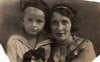
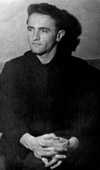
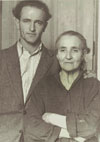
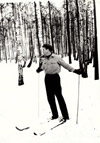
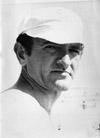
Leonid Mezheritski [leo`nid meʒe`ritskij] was born on 11 December 1930 in Odessa into the family of the architect Yakov I. Mezheritski. He lost his father early on. His mother Berta I. Mezheritskaya (née Dorfman) succeeded in providing him, his two older brothers and a younger brother later born in her second marriage, with an atmosphere full of love.
The childhood ended abruptly: Odessa was bombed practically from the first day of the war, and adolescence came during a time of war. The family had to be evacuated to Central Asia. They suffered hunger and privation and had to work very hard at jobs to which they were unaccustomed. Regardless of that, the family was pervaded by a spirit of sacrifice and charity for all those suffering and in need of help. Leonid’s mother, the two younger sons who had survived the war and an adopted daughter all returned to Odessa in 1949.
Shouldering the heaviest possible burdens with veritably superhuman efforts, Berta Mezheritskaya was able to provide all three of them with the full-fledged education that accorded with their aptitudes and interests. Initially, Leonid entered the architectural section of construction engineering school. His drawing teacher noticed his artistic talent and insisted that he take up the visual arts.
For Leonid Mezheritski, 1949 – 1955 was a period of study at the renowned Odessa Art Academy (now the Grekov Art Academy), founded almost 150 years ago as a drawing school. In the course of its long history, it has doubled as a school, an academy, an institute and a senior artistic studio, while always remaining an institution of academic study. Here students were trained in the traditions of the Odessa school of painting, a colourful and distinctive tradition featuring emotional warmth, a special perception of colour, and a harmony of hues.
Artist considered it a special achievement to be able to work in the studios of the school’s outstanding teachers and magnificent painters, Dina Frumina and Moisey Muzelmacher. Just barely out of school, two of Mezheritski’s works were accepted for inclusion in a regional art exhibit. From that time on and especially up until 1971, when he joined the creative USSR Artists’ Union, he was a regular participant in numerous professional art exhibits.
Later on, he ceased to feel the necessity of exhibiting so frequently, a tendency that can be traced through the list of the artist’s exhibits.
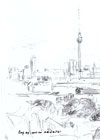
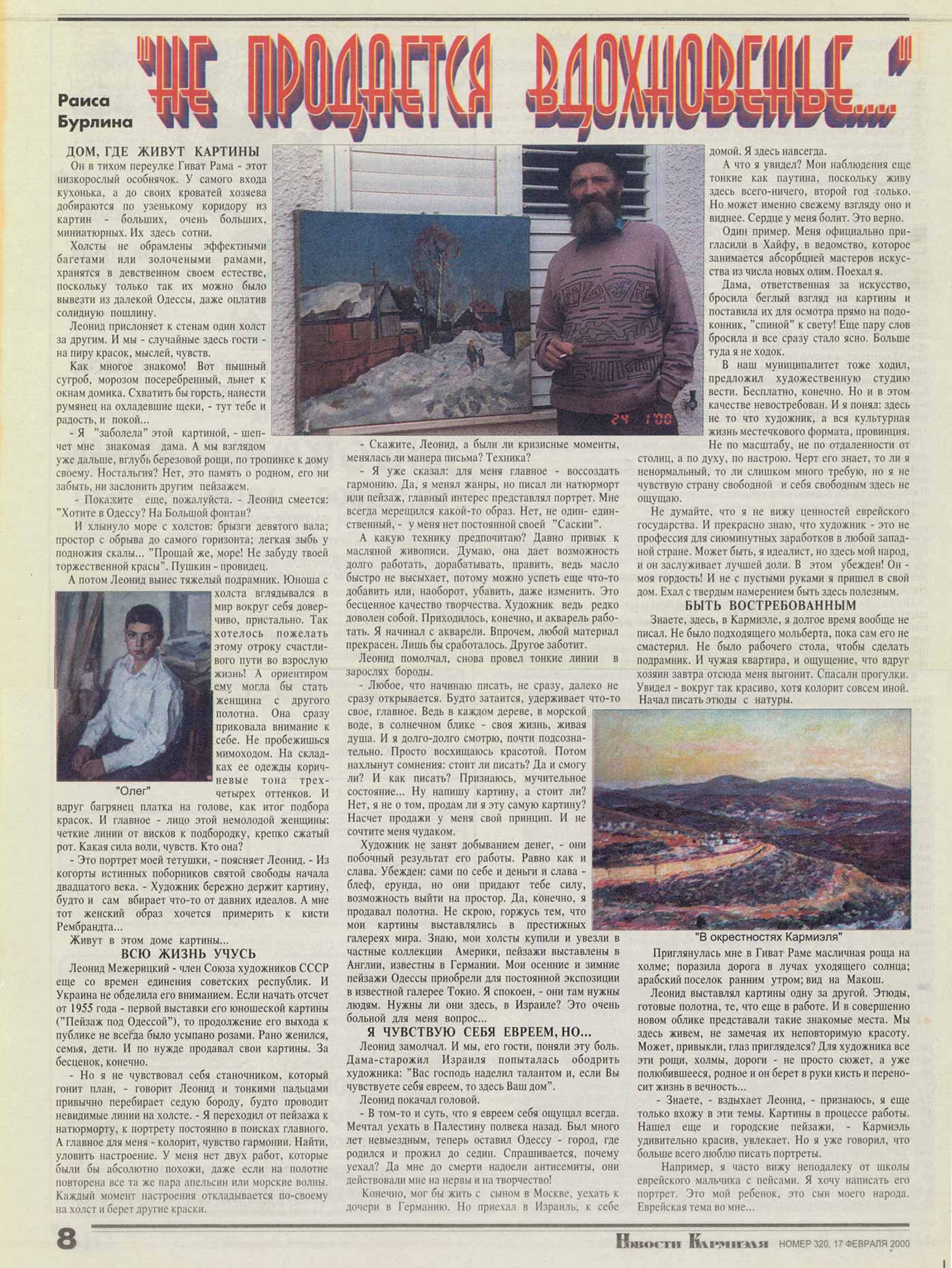
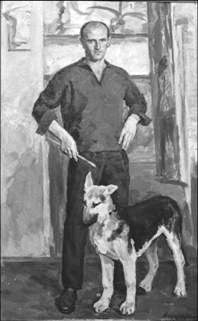
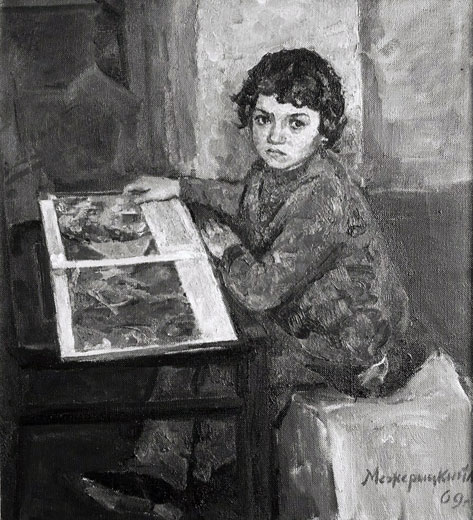
The works of this master, exhibited at these and other institutions, are found in the exhibition collections of public and private museums, galleries and organisations of Ukraine, Russia, England and Japan as well as in private collections in those countries and Germany, Canada, the US and Israel.Leonid Mezheritski worked in the portrait, landscape and still life genres. His basic technique was oil painting. He worked out his own style of painting, based on mastery of the most subtle reception of classical realist art and of his own coloristic achievements. Looking at his portrayals of nature in Italy, Russia, the Ukraine or Israel, or of his Odessa or Berlin urban landscapes, you can perceive their straightforward spirituality, their special mood, their harmony of hue. His still life paintings live their own life, capable of rousing in the observer a gamut of feelings and associations. His portraits not only re-create the physiognomy of a specific human being, but his or her inside world as well; they are illuminated by an inner light.
Even the painter's commissioned "thematic" images that were created under the coercive yoke of work for the USSR Artistic Fund were executed at a very high professional and artistic level. This, incidentally, is indirectly confirmed by the high ratings given to them by contemporary art retailers, as well as how Mezheritski's creative canvasses are reflected in the Rating of Russian Artists published annually.
As is well known, talented people demonstrate their capabilities in various different fields of interest. This is also true of Leonid: He was an excellent chess player, superb mathematician and inexhaustible inventor. He was exceedingly musical, loved classical music and was a wonderful singer. He knew his way around world history, was fond of poetry and recited many works of poetry from memory. He knew how to conduct workshops and loved to teach in general, as did Dina Frumina, with whom he was bound in creative mutual understanding and a general tie of friendship up until the day of her death. He was in close contact with other leading masters of illustrative art living in Odessa as well, including Vladimir Sinitski and Nikolay Shelyuto.
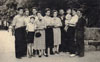
Possessed of a very independent and principled character, he nonetheless knew how to make friends, for years and decades. He was particularly friendly and intimately associated from his student years onwards with Gennadi Malyshev, Iosif Ostrovski, Lev Mezhberg, Valery Prik and other professional colleagues. With some of them, particularly with Tamara Litvinenko-Shelyuto and Mikhail Matusevich, he had a deep friendship. He was a friend of Alexander Rikhter, Ivan Logvin, Vladimir Litvinenko, Alexander Shelyuto, Sofya Kaplun and other interesting people, both artists and non-artists.
It was by no means just anyone that could be blessed with such relations with Leonid (“Leon” to his friends). His passionate and always open-minded nature looked for honesty, humaneness and integrity in others as well. Not surprisingly, he was disappointed with life in some ways, maybe even distressed and hardened; but as a whole, it did not detract from his kindness and optimism. He fought fire with fire, and was happy with small things. He behaved with freedom and was not afraid of popular opinion, which sometimes even regarded him as eccentric.
Mezheritski was married twice. His two children were always linked to him by loving, understanding and devoted relationships. Although they were often cut off from each other geographically, with his daughter Julia (born 1955) living in Berlin from the late 1970s onwards and his son Yakov (born 1962) living in Moscow since childhood, they were constantly in contact and frequently met or stayed with each other.
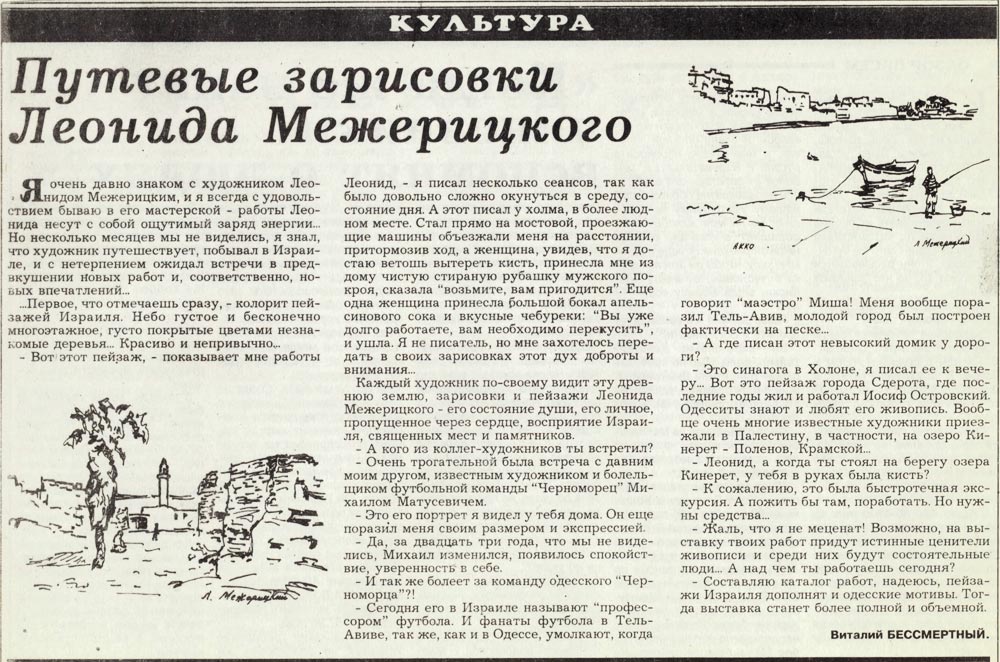
After their mother, B.I. Mezheritskaya, who remained closest to him in worldview and life circumstances, had died in 1993, Leonid and his brother, the painter Eduard Morozov (born 1937), moved to Israel in 1998. There Leonid continued his active creative process. He walked or travelled for many miles in search of the appropriate venue for his artistic mood and the proper lighting and atmosphere; and he created a series of Israeli landscapes as well as still life paintings and portraits.
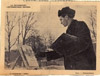
Mezheritski was in general a devotee of the en plein air, and his works always started off from a search for nature. Not infrequently, they were completed in several sittings. From his many trips through Ukraine and Russia and through Italy and Germany, he invariably brought back a great abundance of sketches, some of which were later used in paintings. Even at that stage of completion, however, many of them already had the shape of finished creations.
Mezheritski’s works always perfectly translate nature’s mood. He did not simply have the ability to pick up and use such themes; through his talent, he relayed their special state, thanks to his own past emotional impressions. He had a talent for feeling the moment and changing it into a revelation of his exceptional personality.
Leonid Mezheritski was an outstanding artist, a man with an interesting and complicated life history who had the good fortune to do what his talent had predestined him to do: the art of painting; and that was the essence of his life. He passed away, seriously ill, on 12 November 2007, in Berlin. He is also buried there, in the Jewish cemetery of Weissensee. He was torn from life, full of creative plans and an overwhelming desire and the energy to realise them. He kept struggling and drawing to the very end...